
Reshaping Tradition: A Two-Artist Presentation at Art Rotterdam 2026|Yuma Taru & Pascal van der Graaf
March 9, 2026
From March 26 to 29, 2026, Bug 2 Gallery will participate in Art Rotterdam as the first gallery from Taiwan to be selected for the fair.
At this edition, we present works by Pascal van der Graaf(1979–) and Yuma Taru (1963–). Under the curatorial framework of ReshapingTradition, the presentation revisits history while opening new modes of contemporary generation.
I. Pascal van der Graaf: Reshaping Abstraction and the Shaped Canvas Tradition

Pascal began folding paper and painting at the age of four. Origami taught him how a flat surface could transform into volume; painting familiarized him with color, line, and spatial order. These two practices developed in parallel for decades, yet never fully converged.
At the age of 36, he relocated to Taiwan following his marriage. Immersed in Eastern philosophy, folk belief systems, and temple architecture, his understanding of pictorial space gradually shifted. The layered rooflines and bracket structures of temples, along with Daoist notions of qi and flow, reoriented his perception of surface and structure.
Several years later, he began integrating the structural logic of folding into the canvas itself. The painting surface ceased to be a passive plane; it became a folded and reoriented spatial body. This development of the shaped canvas is not a formal experiment, but the result of decades of technical accumulation and cultural transformation.
What he reshapes is the tradition of abstraction and the shaped canvas—opening a new trajectory from within its historical lineage.
II. Yuma Taru: Reclaiming Tradition Across a Historical Rupture
The weaving tradition of the Atayal people Taiwan was once forcibly interrupted.
During the Japanese colonial period, assimilation policies replaced indigenous cultural life. After the war, further state-driven assimilation led to the erosion of language and craftsmanship. Yuma’s grandmother stopped weaving in her early teens; for that generation, the tradition nearly came to a halt. Such a prolonged rupture made its revival particularly difficult.
At the age of 29, Yuma left her position as a civil servant and returned to her community. She began by visiting elders and studying museum collections, meticulously comparing patterns and techniques. She realized that if only the motifs remained while materials and methods were lost, tradition would be reduced to mere form.
She then proposed a “50-Year Plan,” structured in ten-year phases—from field research and technical reconstruction to indigenous educationand international exchange—advancing step by step.
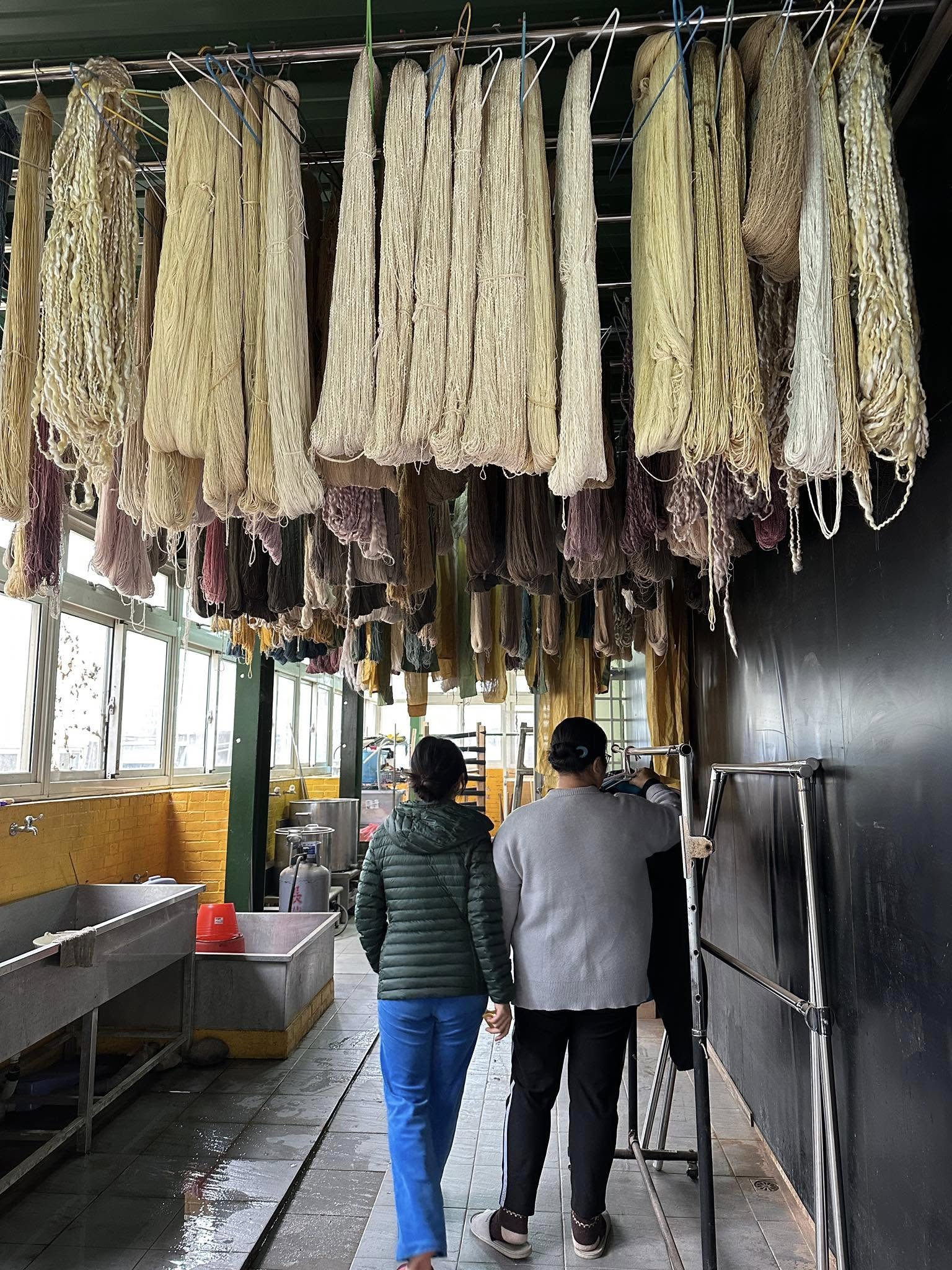
In 2016, she was officially recognized by Taiwan’s Ministry of Culture as a Preserver of Important Traditional Arts. Over the years, she has visited more than 200 Atayal communities and conducted research in the United Kingdom, Canada, Japan, and China. Since 2001, she has reconstructed traditional garments based on museum collections, completing nearly 500 revival works by 2009. She has also established educational systems to ensure the intergenerational transmission of culture.

For Yuma, tradition is not merely technical preservation.
She often speaks about how younger generations must first find themselves in order to determine how they relate to their cultural heritage. She believes culture has no hierarchy; rather, dominant cultures often prevent others from fully expressing their energy. Her work seeks to restore equalityin how different communities perceive one another.
She also advocates for greater cultural space within Taiwanese society—so that diverse communities may fully enact their traditions, and children may grow up with the cultural education to which they are entitled.
She creates, while restoring dignity to cultural memory.
III. The Significance in Rotterdam
This presentation is not a formal juxtaposition, but a dialogue about how tradition may be reorganized in the present.
Pascal reshapes the structural language of abstraction and the shaped canvas.
Yuma reshapes the material and epistemic systems of Atayal culture.
Their paths differ, yet both begin from tradition—generating new forms within contemporary conditions.
Art Rotterdam 2026
Dates: March 26–29, 2026
Venue: Rotterdam Ahoy
Booth: E10
%20cyanoacrylate%2C%20enamel%20and%20spraypaint%20on%20canvas%2063%20x%2059%20x%209%20cm%2005.jpg)

.jpg)