
When Museums Can No Longer Read Their Collections|Yuma Taru and a Disappearing System of Knowledge
April 20, 2026
▌When Museums Can No Longer Read Their Collections|Yuma Taru and a Disappearing System of Knowledge
After Art Rotterdam, we did not immediately return to Taiwan. Instead, we followed Yuma Taru into a very different kind of setting—research institutions and museum storage collections. This journey prompted us to reconsider something fundamental: art is not only about the creation of form, but also about how systems of cultural knowledge are preserved, understood, and whether they can still be read.
During the fair, we met a researcher working at the Leiden Asia Centre. Originally from Taipei, she has lived in the Netherlands for over two decades. When she saw the motifs in Yuma’s work, she felt an uncanny familiarity and pointed to a red scarf she had worn for many years. Yuma took one look and smiled—it was her work. The scarf had been part of a small batch she hand-wove fifteen years ago to raise funds. This unexpected encounter, bridging time and geography, allowed a nearly forgotten object to return to its maker, reminding us that culture is not merely preserved—it continues to circulate through people’s lives.
▌TextileResearch Centre (TRC)
The following day, we visited the Textile Research Centre (TRC) in Leiden. Unlike a conventional museum, TRC functions as a research-driven institution. Its director, Dr. Gillian Vogelsang-Eastwood, emphasized that if textiles are only preserved but not touched or studied, the knowledge they embody will inevitably disappear. As a result, visitors are encouraged—so long as their hands are clean—to handle the textiles, study them closely, and document them through photography.
This openness reveals a fundamentally different approach: the focus here is not on preserving objects as static artifacts, but on ensuring that cultural knowledge remains active and accessible. Over decades, Gillian has built a collection of more than 53,000 textiles from around the world, and has published several major volumes on regional textile traditions and techniques. She is currently working on a publication dedicated to East Asian textiles, which will include Taiwan.

Recently, the Centre was given the opportunity to relocate to a larger historic building, allowing it to better accommodate its growing collection. Plans are also underway to construct a new storage facility in the garden, organizing the collection systematically by region. Although the project has received official approval, it is still actively seeking funding. For an institution committed to preserving and transmitting global textile knowledge, this expansion is not merely about space—it is about the survival of an entire system of knowledge.

During our visit, we also encountered traces of Yuma’s earlier presence. Ten years ago, she had been invited to lead a workshop at TRC and donated a full set of traditional Atayal weaving tools and textiles. Seeing these pieces again, Lungah instinctively began organizing the warp and weft, as if this knowledge had already been inscribed in her body. This kind of unspoken understanding reflects the deepest form of cultural transmission.

▌Wereldmuseum,Amsterdam
The next day, we traveled to the Wereldmuseum in Amsterdam. The museum houses a vast collection of objects brought back during the age of Dutch global exploration and serves as an important resource for anthropological research. However, once inside the storage collection, a critical issue became apparent: although the objects are preserved, their actual functions and cultural meanings are often no longer fully understood.


A curator presented a textile labeled as a “skirt.” Yuma Taru immediately recognized it as a head covering, typically worn during funerals or significant rituals as a sign of respect. Another object included a small pouch; when asked about its purpose, she responded without hesitation—it was used to hold tobacco and flint. These insights did not come solely from written knowledge, but from embodied, lived understanding.
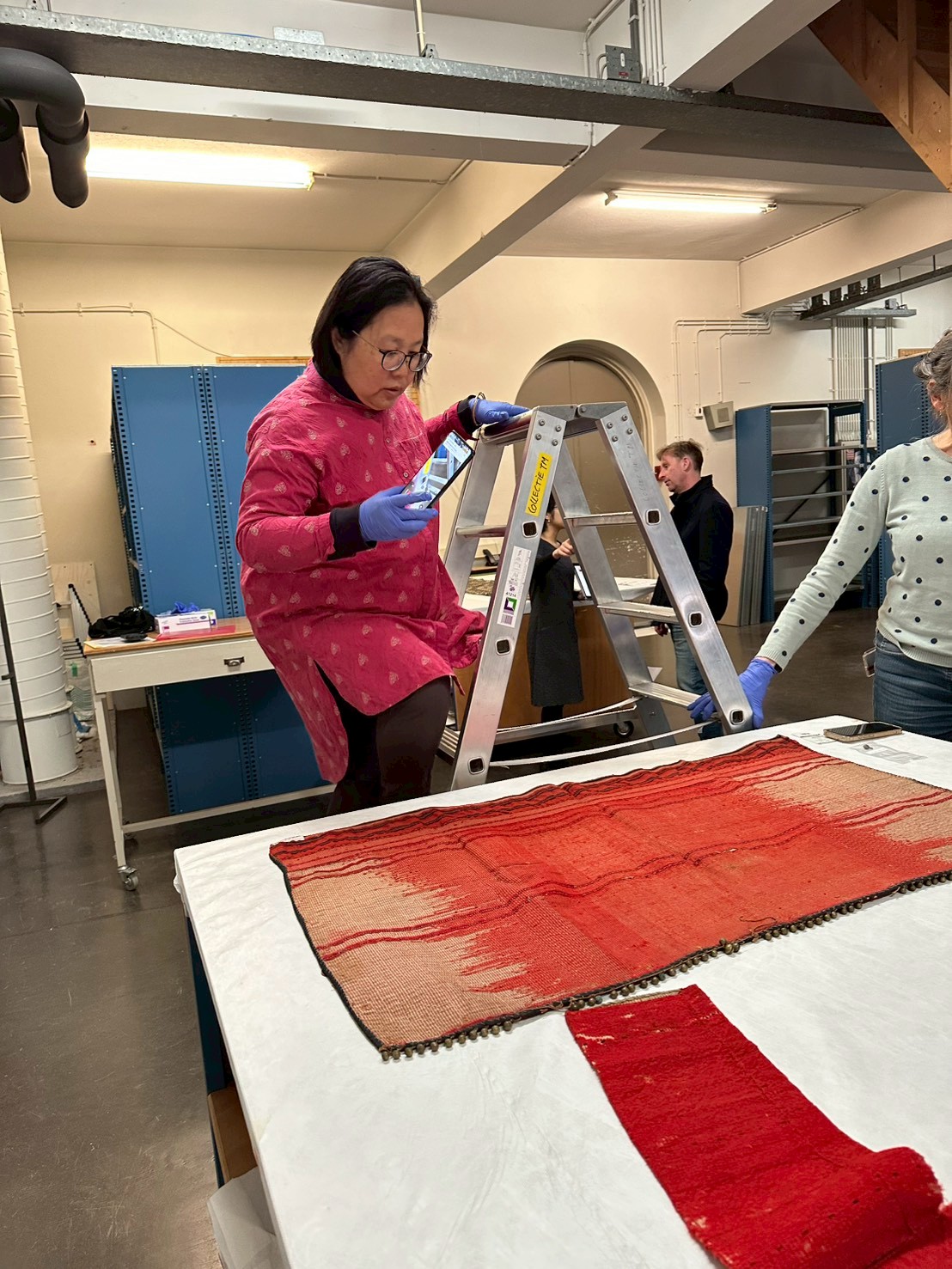
Among the collection was a textile that the museum had previously reproduced. The institution had interpreted it as being composed of multiple pieces stitched together, and therefore recreated it by weaving five separate sections and sewing them into one. However, upon close examination, Yuma pointed out that the original was not assembled in this way. Instead, it had been woven as a single piece, incorporating shifts in technique directly on the loom—two variations in one example, and three in another.
This kind of recognition goes beyond visual analysis; it is grounded in deep technical knowledge and years of hands-on practice. By reading the subtle transitions in the weave, she was able to reconstruct the original making process and correct the existing interpretation. For most viewers, these textiles are static objects. For her, they still retain the movements, decisions, and logic of their making.
In that moment, we became acutely aware of something crucial: museums may possess objects, but they do not necessarily understand them. What Yuma Taru holds is precisely this disappearing ability—the capacity to reconnect objects to their original cultural systems. Her work, therefore, is not simply about weaving as a form, but about reconstructing a way of knowing.
▌Works
With this understanding, returning to her works reveals an entirely different dimension.
.jpg)
A Tender Language
In Atayal culture, elders are expected to speak with wisdom; their words are seen as the accumulation of experience and judgment. Language, in this sense, resembles woven cloth—both soft, capable of connection and inclusion, and strong, able to carry weight and direction. The elongated, flexible form of the work unfolds in space, with threads looping and turning like sentences forming over time. The layering and interweaving of colors suggest that language is never singular, but a structure shaped by multiple experiences. Beneath its apparent lightness lies the weight of responsibility, memory, and transmission.

Quietude
This series is based on Atayal weaving, layered with over twenty materials that gradually obscure the original patterns. In a culture without written language, these patterns once functioned as a system for transmitting knowledge and memory, akin to a form of coding. Over time, however, while the patterns remain visible, their meanings have become increasingly difficult to interpret. The use of black, white, and red echoe straditional Atayal garments, pointing to a condition in which cultural identity persists, even as its meanings fade.
The Bird of Silence
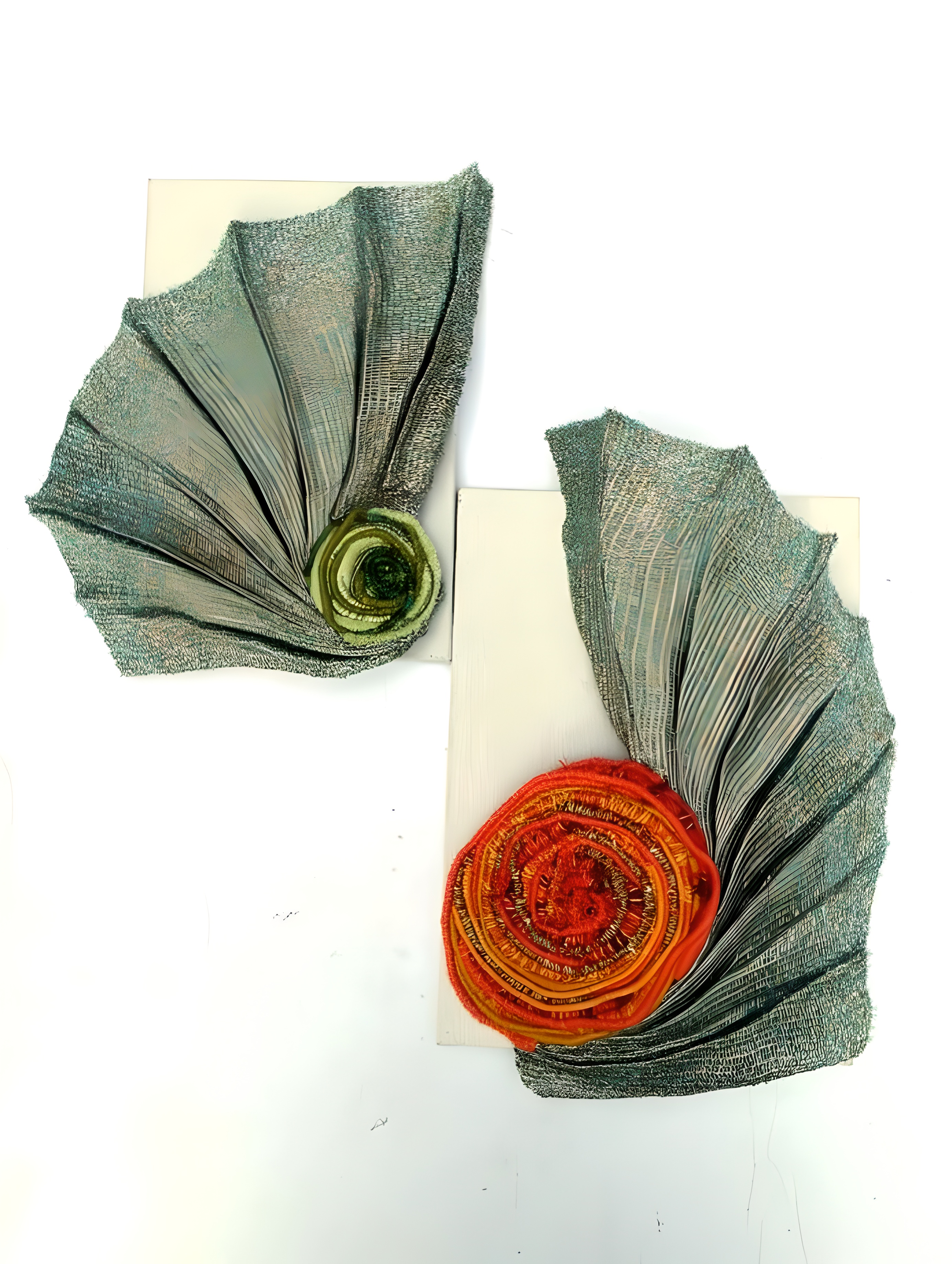
In Atayal tradition, hunters listen to bird calls before entering the forest, using them to assess safety and fortune. Sound was once away of reading the world. This work combines ramie thread with metal wire, creating a tension between softness and rigidity. As humans lose the ability to interpret these natural signals, the birds continue to sing, yet their meaning is no longer received. Silence, here, is not the absence of sound, but the loss of its intelligibility.

Resonant Harmony
Composed of two opposing forms, the work evokes the relationship between sound and echo. Even as the connection between humans and nature weakens, responses persist, albeit in transformed ways. Rather than depicting loss, the work suggests the possibility that connection can be reestablished—though it requires new modes of understanding.
▌Conclusion
This journey made one thing clear: some artists are not only concerned with making works, but with how entire systems of cultural knowledge can continue to be understood and transmitted.
Yuma Taru operates precisely within this space. While museums are still attempting to identify the functions of objects, she is able to read the language and techniques embedded within them. Through her work,these nearly lost systems of knowledge re-emerge in new forms.
If you would like to learn more about the works presented at Art Rotterdam, or receive the full catalogue, please feel free to contact us directly.

.jpg)