
Why Is Contemporary Art Rediscovering Weaving?
April 13, 2026
For a long time, weaving was placed at the margins of the art world.
It was categorized as craft, separated from “fine art” such as painting and sculpture, and often associated with everyday use—textiles, decoration, or functional objects—rather than as a primary medium for artistic thinking.
Yet, looking back at developments since the 20th century, we can see a clear shift: weaving has gradually moved into the core of contemporary art.
1. From Craft to Art: Entering Modernism
This transformation can be traced back to the Bauhaus (1919–1933), one of the most influential art and design schools of the 20th century, which challenged the strict division between art, design, and craft.

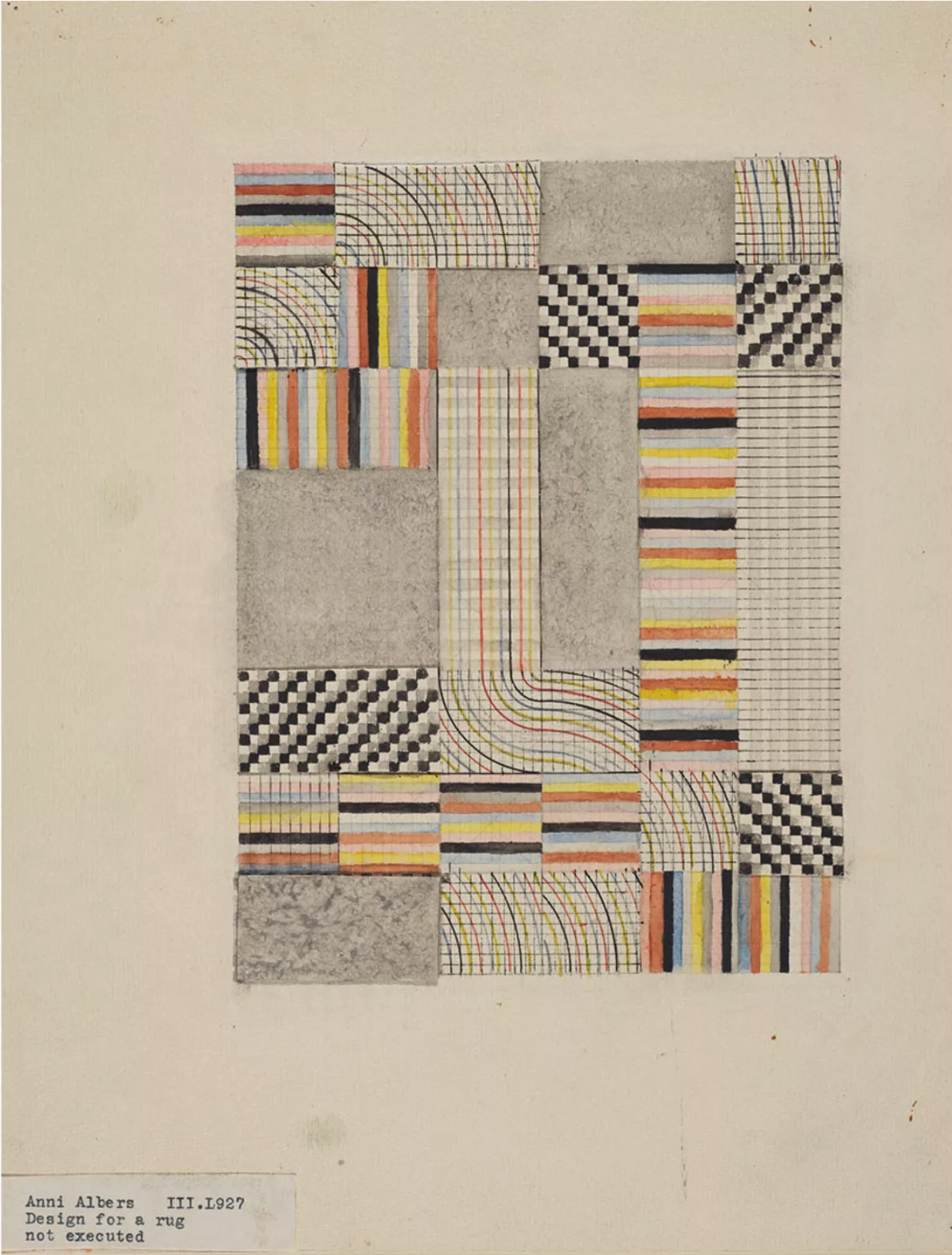
Hand-drawn design sketch. By mapping weaving logic through lines and grid structures, the drawing reveals weaving as a highly structured and conceptual form of artistic planning.
Within this context, Anni Albers(1899–1994) became a key figure. Although initially assigned to the weaving workshop due to gender restrictions, she redefined weaving as a form of artistic language. In works such as Black, White, Yellow (1926), she used structure and color to create compositions comparable to abstract painting.
In 1949, her solo exhibition at the Museum of Modern Art in New York—MoMA’s first exhibition dedicated to a textile artist—introduced the concept of “pliable planes.”
Weaving was no longer a flat object, but a spatial structure capable of shaping and organizing space.
This marked a crucial shift: weaving became something to be seen, experienced, and discussed as art.
2. From Surface to Space: Fiber inContemporary Art
From the 1960s onward, artists began to move beyond the limits of painting and sculpture.
Sheila Hicks (b. 1934), who studied with Albers, expanded this direction further by bringing fiber into space.
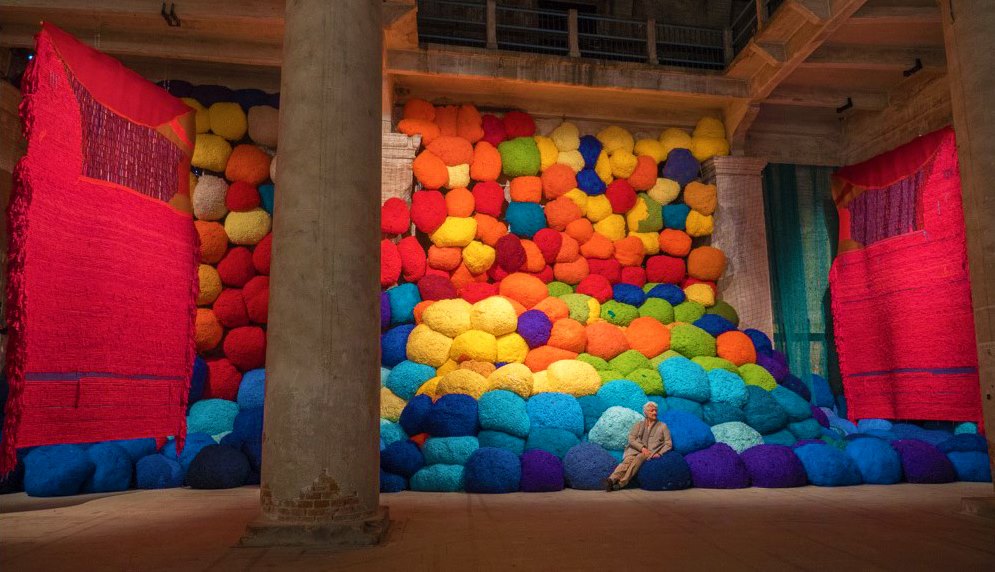
In works such as Escalade Beyond Chromatic Lands (2016–2017), large accumulations of textile elements form immersive environments. Viewers are no longer just observers, but physically engaged within the work.
Her retrospective at the Centre Pompidou in 2018 confirms that fiber has become part of the language of contemporary art.
3. Why Now?
.png)
The renewed interest in weaving today is not a return to tradition, but a shift in focus.
Artists are increasingly concerned with:
- How knowledge is transmitted
- How the body retains technique
- How time is embedded in making
Weaving embodies all of these.
It involves the hand, the material, and the accumulation of time.
In this sense, weaving is not just a medium—it is a way of holding and transmitting knowledge.
4. Another Perspective: Beyond the WesternFramework
From this perspective, practices from non-Western cultures offer another way of understanding weaving. In many ofthese contexts, weaving has always been more than technique—it is closely tiedto life, memory, and cultural knowledge.
Yet within Western art history, it has often been categorized as “tradition” or“craft,” rather than contemporary art.

Yuma Taru’s practice, often presented in large-scale public works and museum exhibitions, engages deeply with space, thebody, and time.
Seen within this broader context, her work suggests that weaving is not something brought into contemporary art—
but something that has always carried the potential to be understood as such.
In the next issue, we will introduce Yuma Taru’s works presented in Rotterdam.

.jpg)