
Yuma Taru|Reweaving Tradition in Contemporary Art
March 16, 2026
In the contemporary art world, Yuma Taru is an artist who resists simple categorization.
Her work is rooted in the weaving traditions of the Atayal people of Taiwan, yet her practice extends far beyond the fields of ethnographic craft or cultural preservation. Over the past two decades, she has developed a unique path that moves between artistic creation, cultural research, and social practice.
Through long-term research and artistic work, she has not only helped revive a weaving tradition that was once nearly lost, but has also brought this cultural heritage into the context of contemporary art.
▌National Cultural Heritage

Image source: SEinsights (Social Enterprise Insights).
In 2016, Yuma Taru was officially designated by Taiwan’s Ministry of Culture as a Preserver of Important Traditional Arts—one of the highest recognitions within Taiwan’s cultural heritage system.
At the time of her designation, she was also among the youngest recipients of this title. The recognition acknowledges not only her deep research into Atayal weaving techniques, but also her long-term commitment to cultural education and intergenerational transmission.
▌Entering the International Exhibition System

Although her work is deeply rooted in Indigenous culture, Yuma Taru’s practice has long entered the international art exhibition system.
She has participated in several major biennales and triennials, including:
- Gwangju Biennale
- Jakarta Biennale
- Asia Pacific Triennial (APT)
- Kanazawa International Craft Triennial
Her work has also been presented at major international cultural events such as:
- Festival of Pacific Arts (Hawaii)
- Santa Fe International Folk Art Market (USA)
Within these contexts, her woven works are no longer viewed merely as traditional craft. Instead, they are positioned at the intersection of contemporary art and cultural research, transforming traditional weaving into a visual language rich in historical and conceptual depth.
▌Museums and Public Art
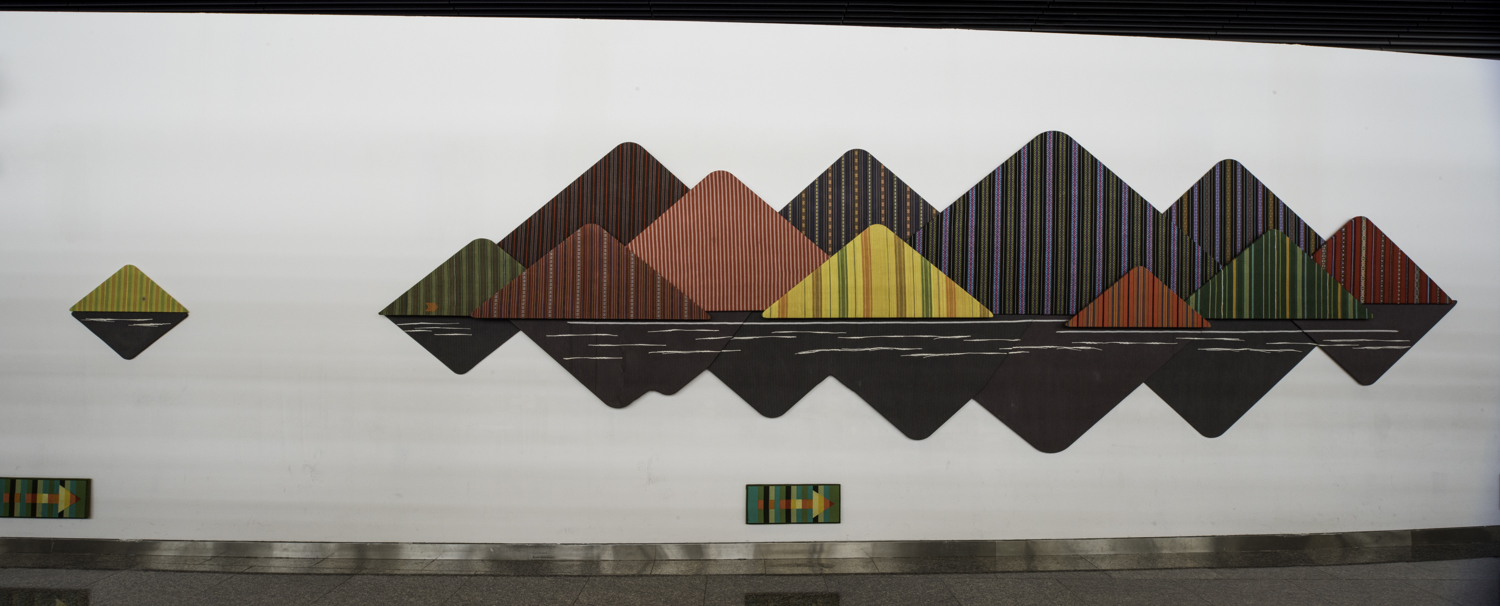
Yuma Taru’s works have been commissioned and collected by several major institutions, including:
- Tainan Art Museum
- Kaohsiung Museum of Fine Arts
- Taichung Fiber Craft Museum
- Taoyuan International Airport Public Art Program
- Taipei 101 Public Art Collection
- 21st Century Museum of Contemporary Art, Kanazawa
In many cases, her works take the form of large-scale textile installations or public art, bringing weaving traditions—once part of everyday cultural life—into urban and architectural spaces.
▌From Research to Cultural Memory

Yuma Taru has long been engaged in the research and reconstruction of Indigenous garments and textiles. Her work has also influenced Taiwan’s broader cultural landscape.
During the production of the epic film Seediq Bale, the filmmakers sought to reconstruct the clothing and patterns of nineteenth-century Indigenous communities. The research and weaving expertise accumulated by Yuma Taru and her workshop provided essential references and technical support.
Through the participation of her team, many of the costumes were recreated based on historical sources, allowing the film’s visual culture to more closely reflect the traditions of Indigenous communities.
As a result, her work extends beyond the art world and has become part of Taiwan’s broader cultural memory.
▌Rethinking Tradition
In Yuma Taru’s practice, tradition is not a static cultural relic. Her work integrates:
- traditional fiber materials such as ramie
- Atayal weaving techniques
- Indigenous motifs and symbolic patterns
- community stories and cosmologies
Together, these elements form a complete cultural knowledge system. Her textiles are therefore not simply fiber artworks, but acts of reweaving cultural memory.
▌Why Rotterdam
At Art Rotterdam 2026, Yuma Taru’s works will be presented alongside the abstract paintings of Pascal van der Graaf.
While Pascal reshapes the formal language of abstraction and the shaped canvas tradition, Yuma reconstructs the material and knowledge systems embedded in Atayal culture.
The two artists begin from different traditions, yet both open new possibilities within contemporary practice.
Within this dialogue, Yuma Taru’s woven works are not merely objects of art, but reflections on culture, history, and the present moment.

.jpg)